Morse code is not a language. It’s a system of symbols, which are transmitted via radio waves or sound waves and then interpreted by the human brain.
The question “how long does it take to learn Morse code” is similar to asking “how long does it take to learn English,” except that Morse code doesn’t have verbs or nouns or adjectives or any other kind of linguistic complexity. So if you want to know how long it takes to learn Morse code, you need to be very specific about what you’re trying to do with it.
Here are four possible goals:
-
Recognizing the alphabet
-
Copying audio by ear
-
Exchanging simple CW-style traffic
-
Chasing high-speed mastery
Let’s go through them one at a time.
Recognizing the alphabet
I’ve seen estimates that suggest it takes 2–4 weeks to recognize the alphabet. That estimate is reasonable for basic alphabet recognition, as long as you don’t confuse it with being able to copy real-time audio. In reality, those are two different things.
There are a couple of ways to get familiar with the alphabet. A chart can help you memorize the letters and their corresponding sounds, but the better path for practical use is to listen to Morse code until you recognize the individual characters as sound patterns. That second method is harder at first, because it asks your ear to do the work instead of letting you count dots and dashes, but it avoids building habits you’ll later have to unlearn. Either way, consistent practice over several weeks matters. If you spend 15–30 minutes every day practicing, you’ll probably be able to recognize the alphabet within a few weeks.
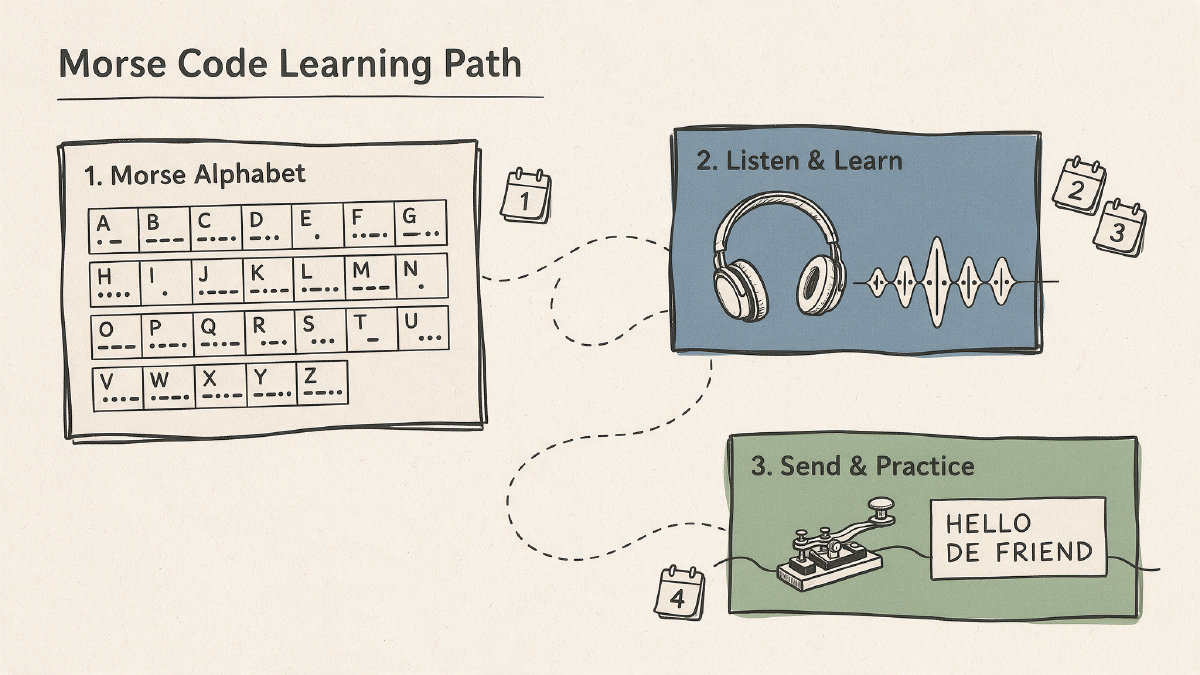
Copying audio by ear
If you want to be able to copy audio by ear, it will take longer. This is because you need to develop your ability to recognize the patterns of the Morse code symbols. You also need to develop your ability to distinguish between different types of signals, such as the difference between a letter and a number.
In order to develop these skills, you need to listen to a lot of Morse code. You can start by listening to short messages and gradually increase the length of the messages you listen to. As you become more familiar with the patterns of the Morse code symbols, you’ll be able to copy audio by ear more easily.
Exchanging simple CW-style traffic
Once you’ve learned how to recognize the alphabet and copy audio by ear, you’ll be ready to exchange simple CW-style traffic. This means sending and receiving messages using Morse code. To do this, you’ll need to develop your ability to send and receive Morse code quickly and accurately.
You can start by sending and receiving simple messages, such as “Hello” and “Goodbye.” As you become more comfortable with the process, you can gradually increase the length of the messages you send and receive. Eventually, you’ll be able to exchange messages back and forth with others who are also learning Morse code.
Chasing high-speed mastery
If you want to chase high-speed mastery, it will take even longer. This is because you’ll need to develop your ability to send and receive Morse code at a faster pace. In addition, you’ll need to develop your ability to distinguish between different types of signals, such as the difference between a letter and a number.
To develop these skills, you’ll need to practice sending and receiving Morse code regularly. You can start by practicing with a partner, and then gradually increase the speed at which you send and receive Morse code. Eventually, you’ll be able to send and receive Morse code at a high speed. One commercial lesson page estimates 2–3 months to reach 15–20 WPM, and 6–12 months to reach 25+ WPM, if you keep up 15–30 minutes of daily practice.
Self-reported learner experiences
The above estimates are based on the assumption that everyone learns Morse code at the same rate. However, this isn’t always the case. Some people learn Morse code faster than others, while others take longer to master it. There are many factors that influence how quickly someone learns Morse code, including their natural ability, their motivation, and the amount of time they dedicate to practicing.
Some learners report that they were able to complete a course in Morse code in just a few months. Others took much longer to reach the same level of proficiency. For example, one forum learner, Bruce R Bain, wrote that it took him about nine months to learn all the numbers and letters, after which he began working on punctuation. Another forum learner, Helge, wrote that even in his tenth month—after the LCWO lessons, CW Ops courses, and close to an hour of training most days—he was still not comfortable at 15 WPM on the air. At the faster end, one LCWO user reported completing all the lessons in exactly three months. A 2025 forum participant was at the other end, writing that after about two years of learning, he still could not make a decent QSO.
It seems like there are a lot of variables that determine how quickly someone learns Morse code. Some people seem to pick it up quickly, while others take much longer. The only thing that seems to be consistent is that it takes a lot of time and effort to learn Morse code. Even though it might take a long time to learn Morse code, it’s definitely worth it. Once you’ve mastered it, you’ll be able to communicate with people around the world using Morse code.
Practice routine
The key to mastering Morse code is consistency. You should try to practice it every day, even if it’s just for a short period of time. The best way to practice is to use a variety of resources, such as books, online courses, and practice software. You can also practice with a partner, either in person or online. Finley’s Koch-method guide recommends committing to at least one 15–30 minute training session every day.
Another important factor in learning Morse code is repetition. The more you practice, the better you’ll become at recognizing the patterns of the Morse code symbols. You should try to vary the type of practice you do each day so that you don’t get bored.
When it comes to progress, there’s no single answer. Everyone learns Morse code at a different pace. Some people seem to pick it up quickly, while others take much longer. The only thing that seems to be consistent is that it takes a lot of time and effort to learn Morse code. Even though it might take a long time to learn Morse code, it’s definitely worth it. Once you’ve mastered it, you’ll be able to communicate with people around the world using Morse code.
Progression criteria
Under Koch-style training, progression from one character to another is determined by copying accuracy. In particular, you wait for roughly 90% copying accuracy before adding a new character to your repertoire. Rushing forward without waiting for recall to stabilize leads to poor long-term memory.
Character speed vs effective overall speed
There’s also a distinction between character speed and effective overall speed. Character speed refers to how fast you can send each individual symbol, whereas effective overall speed refers to how fast you can send entire messages. A higher character speed lets you hear each complete symbol at a realistic pace, but it does not automatically mean a faster overall message; wider spacing can keep the effective overall speed much slower. However, character timing must be set carefully so that beginners hear the complete sound pattern of each symbol instead of counting elements. Finley describes Koch training at 20 WPM character speed and at least 15 WPM overall, adding another character after 90% accuracy. CW Ops mentors have reportedly suggested 20–25 WPM character speed, with slower effective or Farnsworth spacing, so you hear the sound rather than counting or using a lookup table.
Finishing lessons or knowing a chart does not automatically make a simple exchange easy. There is an extra bridge from structured drills to continuous audio, prosigns, callsigns, numbers, and QSO rhythm.