When I was learning Morse code, the only way that I could practice tapping International Morse was on my desk, using my hand or a finger. I had a simple rhythm to tap, though: a dit was one quick tap, and a dah was held contact, or simply tapped once for about three dit-lengths.
Morse Timing Units and Gaps
The timing is defined in units, with each unit equaling the time of a single dot. The dah is three dits, and the spacing depends on whether the marks belong inside one character, between two letters, or between words. If you’re working with someone else to send and receive messages, you’ll find it’s easiest to exaggerate the pauses so they can be clearly heard. Otherwise, these gaps will become indistinct.
A dit is just one tap. Three rapid dits are a separate rhythm, not a longer dit, so keep the marks distinct as you practice. Either way, you’ll need to maintain a strict pattern of rhythm when you begin to practice sending messages in Morse. In addition, you’ll need to learn the basic timing structure behind how letters and words are spaced apart.
Inside-character gap = 1 unit
Letter gap = 3 units
Word gap = 7 units
For example, here’s the word “HELLO” represented in International Morse:
HELLO = ···· · ·—·· ·—·· ———
Each of the characters inside HELLO are separated by exactly three units of silence, which equates to one dah length (since we have defined a dit as being one unit). To hear a word gap, we would add seven units of silence between HELLO and the next word.
Now, here’s how this translates into time:
Three dits = one dah length
One dah length = three units of silence
Seven dits = seven units of silence
So, if you were to create a sequence from E to T (and everything in between), it would look like this:
E = ·
T = —
I = ··
M = ——
A = ·—
N = —·
S = ···
O = ———
Rhythm Contrast Training
Rather than trying to memorize the alphabet, consider these character sequences to be contrast training. You can move from just a single mark (E or T), to matched pairs (such as two dits for I or two dahs for M), and then to other combinations. This allows you to build up to sequences of three dits, four dits, or repeated dahs, until the rhythms become familiar.
From there, the goal is to slowly work your way through individual letters into small groups of letters, such as two-letter words or three-letter words. While practicing, try to keep every letter boundary and word boundary audible by keeping track of the spaces between the different parts of the message.
Eventually, the aim is to practice away from a dot-dash chart. When sending and receiving becomes second nature, it’s easier to treat each character as a complete rhythm rather than a sequence of individual dots and dashes.
Instead, say or tap out the whole pattern, making sure that the receiver has the opportunity to confirm their interpretation against the chart. Once the entire sequence has been completed, the sender can move on to another group of letters or words.
Sender and Receiver Partner Drill
While practicing in pairs, you might consider the partner drill where one person acts as the sender and the other as the receiver. The sender should pick a short known set or simple greeting and tap it out. After the receiver hears the complete sequence, they should write down what they think the message is and check before confirming.
If they get any of the messages wrong, the sequence should be replayed once to give the receiver a chance to hear the message again. However, if the receiver gets it right, no replay should be necessary. After all, the key to successful communication lies not only in knowing how to send a message but also in understanding how to receive it accurately.
Common Tapping Mistakes and Timing Fixes
As a beginner, it’s easy to make mistakes while tapping. One common mistake is flattening dits and dahs, resulting in messages that blur together. For instance, clear timing would involve the sender tapping out three dits for S, leaving a three-unit letter gap, and then tapping out three dits for another S. However, flattened dits result in the sender failing to leave that three-unit space between the two sets of dits.
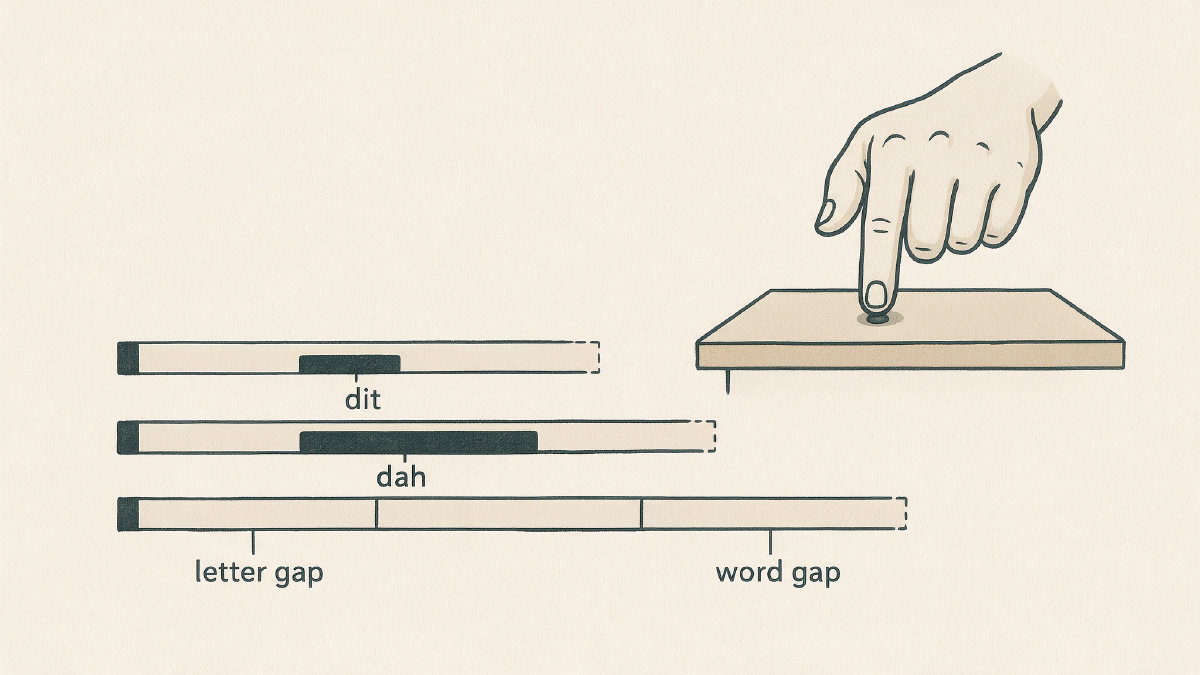
Another issue arises when beginners fail to take note of how long a letter should actually be. They may be aware of how much space exists between the letters, but not how long the letter itself should be. To avoid confusion, simply remember that when a character starts with a dah, the sender holds contact, or taps for three dits, and then pauses.
Some people rush through the process, creating a continuous stream of sound without paying attention to the spacing between letters. Others spend so much time counting every mark that they forget how much space should be placed between each letter or between words.
In order to restore your ability to tap International Morse effectively, slow down. It doesn’t matter how fast you tap as long as you understand the ratios and can restore the appropriate amount of time between each letter and word.