I’m going to show you how I teach myself Morse code. It’s not the only way, but it’s the best beginner routine I know of.
The best beginner route for learning Morse code is sound-first reception. This means that you should hear complete timed character rhythms before trying to interpret them as dots and dashes. You should use dots-and-dashes only as a lookup or confirmation aid, and avoid treating a visual chart as your main skill. In other words, you want to get good at hearing International Morse code, and using the written dots and dashes only when you need to confirm what you heard.
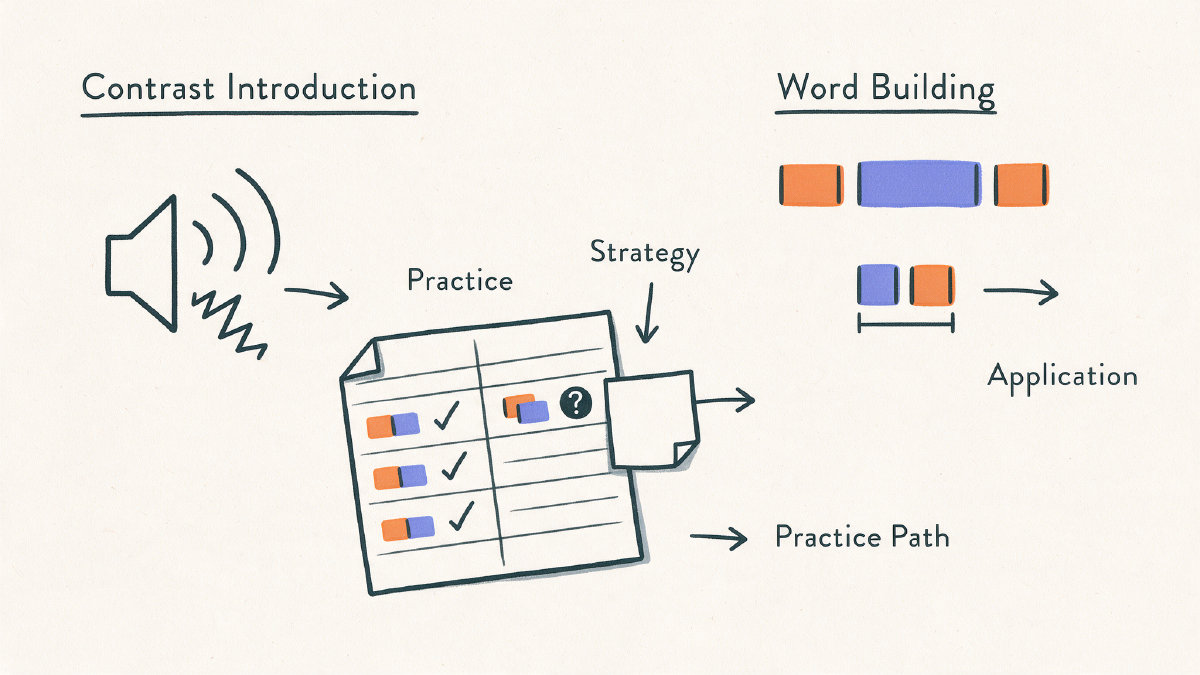
Core timing model
Let’s start by understanding the core timing model that beginners must preserve. Here are the standard timings:
1 dot unit
3 dash units
3-unit letter gap
7-unit word gap
Word gaps are longer than letter gaps because they’re supposed to represent “silence” between words. But if you collapse the letter and word spacing into each other, then copying becomes just guessing. So we have to keep those spaces intact while we learn the sounds.
Daily beginner routine
Here’s a repeatable short daily routine:
Keep playback steady. Don’t speed up or slow down the audio. If you do, you’ll be confusing yourself about what you’re listening to.
Use a small contrasting set. Pick 4-6 characters, maybe with some different patterns. For example, maybe pick S (…), E (.), T (-), and H (...).
Listen before checking. Play the audio, and then after you’ve heard it all, check the answer.
Write or type the answer. If you’re practicing on paper, write out the letters you think you heard. If you’re typing, type the letters in order.
Replay misses. If you missed something, replay it again. If you still can’t figure it out, look it up and then try it again.
Log confused character pairs. When you miss a character, log the pair of characters you thought it was. That will help you remember what to look for next time.
If you follow this routine every day, you’ll get better at recognizing the sounds of the alphabet pretty quickly. The key is to keep the same basic pattern of repetition and review. You don’t have to practice for long each day — even 10 focused minutes is enough. And you don’t have to practice every day — even 15–30 minutes daily is enough. As long as you stick with it, you’ll eventually get good at reading Morse code.
Koch progressive training
One approach to this kind of training is Koch-style progressive training. With this method, you go through rounds of listen-copy-review, where you hear random audio characters from your current set, copy them down, and then review any errors. Once you reach a chosen accuracy threshold, you add a new symbol to your set.
This is a very effective way to train, and I recommend it for most people. But there are some important variations to consider. First, fast Koch character presentation may work well for some people, but gentler valid starting speeds are better for others. The purpose of Koch-style training is whole-pattern perception, rather than forcing every beginner to begin at 20 WPM.
There are gentler ways to build toward that range. One common curriculum starts at 12/8, then moves to 12/10, and later to 12/12. In each setting, the individual characters stay at 12 WPM while the second number controls the effective pace, including the extra spacing. Whatever stage you’re on, make sure that you’re focusing on rhythm rather than counting.
Farnsworth timing is another useful scaffold. Farnsworth timing involves making the individual character sounds faster, while stretching the spaces between characters and words. This helps you develop the ability to recognize whole patterns without having to count each mark individually. Eventually, you’ll remove the extra thinking time and move back to normal speed.
Progressing through the alphabet
Here are the rules for progressing through the alphabet:
You can only add a character to your set once you’re able to answer the current set immediately. You shouldn’t guess or second-guess your answers.
You can only raise your speed once you’re able to answer the current set with clear spacing. Again, no guessing!
Your accuracy leads both your set size and your speed. Accuracy is the most important thing. Don’t worry about how many characters you’ve learned yet, or how fast you can read. Just focus on getting the right answers.
Transfer to short words
When you’re ready, you’ll move on to the transfer stage. This is where you move from isolated symbols to unrehearsed short words. At first, you’ll probably find this difficult. But if you use one-play copying, compare your answer with the source, and review missed sounds rather than reciting the alphabet in a memorized order, you’ll improve quickly.
Here’s how I like to do it:
TEST
RADIO
TIME
CODE
Listen once, and type what was heard.
Compare panels. If you made a mistake, play the audio again.
Don’t recite the alphabet in a memorized order. Instead, type the words that were used in the test.
Practice frequency and progress
How often should you practice? I recommend daily practice. Even 10 focused minutes is enough. If you’re feeling particularly motivated, you can do 15–30 minutes of daily practice. If you’re feeling tired, you can just do a quick 10-minute session. Either way, it’s scalable.
What’s realistic progress? It depends on how much time you dedicate to learning Morse code. If you spend 15–30 minutes a day on it, you might expect to learn the basic alphabet in 2–4 weeks. If you keep that practice going, you might expect practical 15–20 WPM proficiency in about 2–3 months. But these are just estimates — you’ll end while your attention is still steady.
Common beginner mistakes
There are several habits that sabotage beginners when they learn Morse code. Here are the ones I see most often, along with the corrective move I recommend in my routine:
Counting every mark forever. Beginners often fall into the trap of counting each mark instead of perceiving the whole pattern. My routine fixes this by keeping playback steady and requiring immediate recognition of whole patterns.
Flattening silence. Beginners often ignore the silent gaps between characters and words. My routine fixes this by keeping the spacing intact and requiring immediate recognition of whole patterns.
Practicing too fast. Beginners often try to go too fast and force themselves to count. My routine fixes this by using slower speeds and scaffolding techniques like Farnsworth timing.
Guessing unknown input. Beginners often guess at characters they don’t know instead of looking them up. My routine fixes this by using smaller sets and requiring immediate feedback.
Alphabet in order only. Beginners often feel like they need to learn the alphabet in order. My routine fixes this by using smaller sets and requiring immediate feedback.
Smaller sets. Beginners often feel like they need to learn the whole alphabet at once. My routine fixes this by using smaller sets and requiring immediate feedback.
Clear gaps. Beginners often ignore the silent gaps between characters and words. My routine fixes this by keeping the spacing intact and requiring immediate recognition of whole patterns.
Immediate feedback. Beginners often wait until the end of a session to correct their mistakes. My routine fixes this by requiring immediate feedback.
Learn 12 preset. Beginners often feel like they need to learn the alphabet in order. My routine fixes this by using smaller sets and requiring immediate feedback.