The Morse code alphabet contains 26 letters. Each letter is represented by a combination of dots and dashes. However, you do not need to learn the entire alphabet to send and receive messages using International Morse code.
You can begin sending ordinary International Morse text immediately. You will simply encode each letter in the word into its corresponding dot-and-dash representation, preserving the rhythm between the letters as well.
This article contains several sets of short messages, each one of which uses just a few letters from the International Morse alphabet. They are all relatively easy to memorize and transmit.
Timing and spacing
There are several elements to consider when transmitting Morse code, however. There’s the dot and dash, how long they should be, and then there are the gaps between characters. Between the dots and dashes inside the same character, and then between characters. And between words.
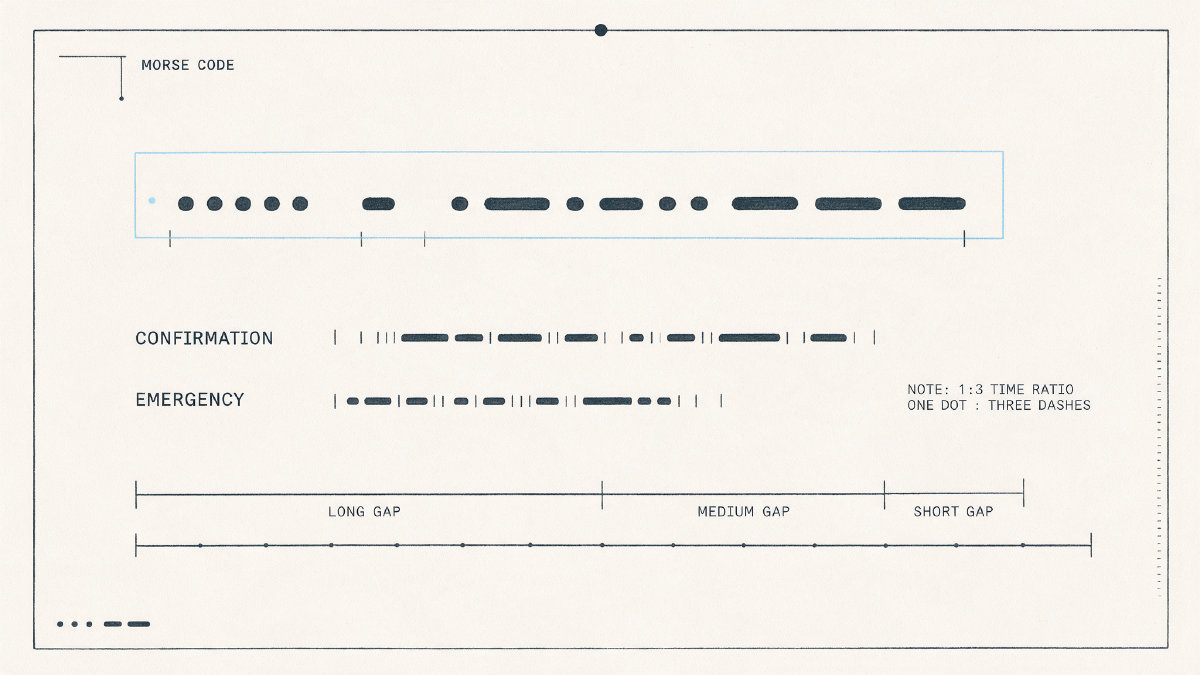
To clarify what we mean by those terms, take a look at the chart below:
A dot = 1 unit
A dash = 3 units
Gap within a character = 1 unit
Gap between characters = 3 units
Gap between words = 7 units
In addition to that, printed spacing and slashes also play an important role in making your message readable. The / slash is its own Morse punctuation character (-..-.) and is often used as a separator, such as between words in printed examples.
Here’s what it looks like for the word “HI”:
H is ....
I is ..
So H I would be written like this: .... / .., or with ordinary letter spacing: .... ..
Common Morse phrases
Below are some common phrases that beginner Morse code operators can use. They are organized according to how often they appear in everyday conversation.
Greeting
HELLO
YES
NO
OK
Help
HELP
SOS
Wait
WAIT
READY
DONE
OVER
ROGER
COPY
Other
THANK YOU
GOOD LUCK
In Morse, HI is .... / ..; HELP is …. . .-.. .--.; SOS is …---…; HELLO is …. . .-.. .-.. ---; YES is -.-- . ...; NO is -. ---; OK is --- -.-; WAIT is .-- .- .. -; READY is .-. . .- -.. -.--; DONE is -.. --- -. .; OVER is --- ...- . .-.; ROGER is .-. --- --. . .-.; COPY is -.-. --- .--. -.--. These complete words are good practice phrases.
Emergency and operating signals
When sending an emergency signal, SOS has a very specific meaning. While many people have been taught that “help” is represented by a single letter — usually the letter “H” — that’s not the case. When a distress call is made, the signal SOS is a single run-together pattern: three dots, followed by three dashes, followed by three dots again. This signal is reserved specifically for actual emergencies, so don’t try to use it for anything other than that.
However, the phrase HELP is four normal letters, each encoded separately. So it would be transmitted like this: …. . .-.. .--.
Similarly, the word OVER is four ordinary letters: O, V, E, and R. It is transmitted as --- ...- . .-., not as a two-letter abbreviation. If you want the separate signal for “verified,” that is VE (also written SN). In this way, they are treated similarly to the word YES, which is another form of abbreviation, although the abbreviation is itself another word. The letter K doesn’t mean “copy”; it means “over,” inviting the other station to transmit. “Received” or “Roger” is R.
For now, it’s enough to keep the ordinary words separate from those shorthand signals.
And what about the word STOP? It’s ordinary text, made from four separate letters: S, T, O, and P.
The operating signals are shorter: K is -.- and R is .-. These procedure signs are standardized shorthand, distinct from ordinary abbreviations.
All right, we’ve seen what a full message might look like. What about the labels used to identify the beginning and end of a message or a contact?
Procedure controls
Here’s where the procedure controls fit into a typical message:
KA/CT = The start of the message
BT = A section break within the message
AR = End of message
SK = End of contact
If you wanted to label your message with a procedural control, you’d send the letters in that control without the usual gap between them. For example, KA or CT would represent the starting signal.
Once again, the difference is important. These are not meant to be used for casual purposes; rather, they are standard procedure controls designed for radio communication.
That’s fine, though. After all, the point of learning Morse code is to use it creatively. You could create personalized messages, names, dates, and even puzzles using plain text. Morse code isn’t just used for formal communication, after all.
And it doesn’t take a lot of time. Let’s take a closer look at how to use it effectively.